Wing Chun split into Elements

Wing Chun is a big pool. How much water can you take, however, it is up to you. This is a good sentence indicating that the elements that make Wing Chun are many and which must amalgamate, so that each element is part of the whole and the whole is formed by the contribution of each element.
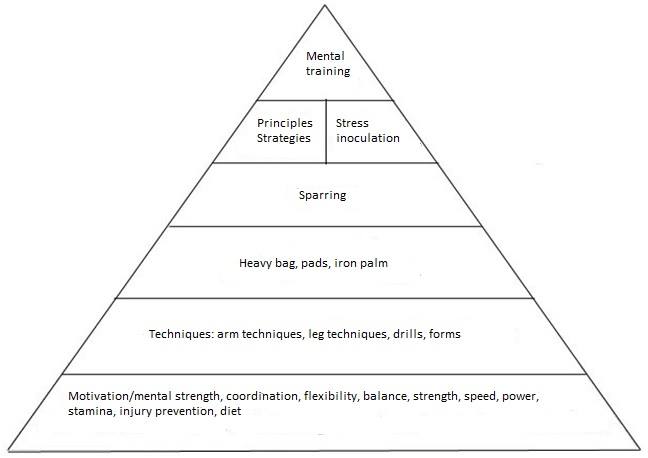
For analysis purpose, however, it is better  to examine the various elements individually and use a new structure: the pyramid.
The pyramid that I take into consideration is inspired by the Rooney’s and adapted by me to Wing Chun.

Here it is:
 

Pyramide

Why a pyramid structure? Because, as in a normal building, you have to start from the bottom by building one floor at a time and the lowest level must be so strong as to support the plans that are above.
Let’s see them one by one.


The base
Like any base, also the one our  pyramid must be solid. The more solid is the basis, the more stable will be the entire structure.
At the base we find different elements, some physical, some mental, some concerning the behavior.

Motivations  are the things that prompted us to begin the practice of Wing Chun. Everyone will have their own. Motivations are essential for understanding our goals and ensure that the training will  meet those goals. Note that “finish the system” to me is not a goal but an instrument, or an intermediate step to achieve a goal. It is like trying to learn to drive a car to keep it in the garage and drive  occasionally round the block.

Finish the system is a natural condition for anyone who begins the training.

Mental strength is what we need to bear the training. It can be a mental strength to withstand the fatigue (or pain) of the training or even the patience, very important in Wing Chun.

Motivations and mental strength combined, create the “reliability” of the practitioner in training.

For “reliability” I mean constant attendance at training sessions and commitment during the sessions.

We then go to purely physical / athletic attributes: coordination, flexibility, balance, strength, speed, power and endurance.

Injury prevention.

Here the responsibility is split between teacher and student.
For injury prevention I mean:
1) The achievement of awareness, and evaluation ability, of the point and the limits of physical ability in terms of strength, balance, flexibility and strength so the practiotioner doesn’t exceed and hurt himself;
2) Alternate adequately activity and rest/recovery period;
3) Use the appropriate kind of training  to your own physical and technical level;
4) Always use the proper equipment for the activity you’re doing;
5) Always keep the mind focused on what you are doing.

Diet

Wing Chun tell  us how and what should we eat? Of course not. What is meant here is that adequate food has a dual beneficial effect:
1) It improves our body and our health. It is said that we are what we eat;
2) Following a diet assumes that we adjust our  behavior to rules. It a behavioral training, an attitude that will be useful during practice.

But this means that the Wing Chun practitioner can never “go out of the rules”? Of course not. Let us remember that as a good Buddhist style, there is always the middle way. The ability to set and see if we are in the way to the goal is the real goal.

Technical specifications

Here we are in the real technical training.
At this level are covered:
1) All single techniques with the arms and legs;
2) The forms;
3) All the drills and all the patterns.

Impact training

The knowledge of all of the techniques and drills is not useful if at the first impact the wrist, the fist or any other part of the body that is hitting, will break.

That’s why at the upper floor there is the impact training.
This can be done:
– At the heavy bag;
– Using  shields, pao, focus glove…;
– Training  the Iron Palm sequence, or “conditioning” the various parts subject to impact.

Even if it is not the most important kind of training, even the wooden dummy can be used as impact training for  conditioning arms and legs.

Sparring

The next level is the practical application of techniques in a free environment.

Principles and strategies and/or “stress inoculation”
On this level, I put two very different elements together. I did it because they could be the crossroad that leads the practitioner to take one way rather than the other, emphasizing one of these elements.

Principles
Up to this point the practitioner has trained his body and the practical application of Wing Chun. He is now ready to understand the rules from which come techniques and drills. He is ready to understand the principles of Wing Chun.

his will allow him to break free from the chains of the drills. It will allow him to have personal applications that still will respond to the system principles.

Finally he stops being a robot and Wing Chun will become like a dress that will suit perfectly him.

By understanding the principles, the practitioner will also realize the various strategies in Wing Chun, which will enable him to adapt the fight to his opponents and not try to fit all the fights to a single strategy.

Stress inoculation

Many people learn Wing Chun for self-defense.
Wing Chun, as a tool to deal with other human being, can certainly also be used in for self defense.

There is a little problem, that sometimes is forgotten, until someone unfortunately is involved in that kind of event: an aggression, a “street fight” creates a high stress. Stress drives our body and our mind in a way completely different from how they work in the gym.

The greater the stress, the greater the psychophysical changes: adrenaline shot into the circulation changes functioning of the muscles, heart beats increases and the mind gradually decreases the ability to do “fine” movements.
The nice thing is that the amount of stress is personal, it depends on the individual evaluation of the danger.

It means that the same event can be traumatic for someone and a walk in the park for another one.

Training for years and not be able to fight when we need, could be  more traumatic than the event itself.

It ‘my opinion that those who approach Wing Chun for self defense should become familiar with the effects of stress on their body and their  mind.

But there is a little problem: the stress of a real fight  cannot be reproduced in the gym!

What can be done then?
Two things:
1) Train and repeat to exhaustion the correct techniques;
2) “Get vaccinated” to stress.

Let’s start from the first thing: repeat techniques and sequences.

This is one of the things that nowadays are criticized in Wing Chun. Why do I have to repeat, repeat, repeat, repeat …?

It is seen as something archaic and based on an outdated education system.

Instead the repetition has its own beneficial effect during stress: in a fight with a very high stress factor, you will not elevate yourself to the level of the comparison, but you will go down  the level of training.

It means that when things get really serious and you perceive a real danger, the mind and the physical adapts to it. If the danger felt  is really high, we take what we might call the “automatic pilot”.

If you have witnessed or have heard stories of people after a fight and they said they did not remember what they had done, you have an idea of the “automatic pilot”.

The good news is that the “automatic pilot” does it all on its own, even though we have retreated in the most protected corner of our mind to pray. The bad news is that the automatic pilot takes resources from instinct and instinct is  only built  by repetition of gestures.

If repetition is correct, the “autopilot” will act properly, otherwise it will do exactly the mistakes done in training.

“Get vaccinated to stress”

As we have seen, fighting is stress, and stress creates physical and psychological changes.

These changes are good until a certain point: the body prepares itself to do  2 of the 4 “F” – fight or flight.

These changes are good. Up a certain point, however, they start to work against us.

What can be done then?

We use the fact that the level of stress depends on our perception. If we change the perception, we will also change the level of stress.

To do this is a little as with vaccinations: we  put a pathogen element in a controlled manner so the body  can  recognize and fight it.

With stress is done exactly the same way. There are methods called “stress inoculation” that do just that: introduce stressors in a controlled manner, in order to raise awareness and   the practitioner becomes familiar with the new state.
The top: the mental training

Here we come to the last element, the top floor of our pyramid.

The top is dedicated to the mind.

We usually tend to think that performance depends only on potential of  physical and technical-tactical level.

Actually not. If we write the formula of performance, this would be:

Performance = potential + – convictions.

In performance,  beliefs that we have  play a big role.

Negative beliefs   subtract points to the performance:
Performance = potential – limiting beliefs
Positive beliefs are add  points to the performance:
Performance = potential + empowering beliefs
Since we can not turn off our minds and therefore our beliefs (except in case of “automatic pilot”), we should work in order to have empowering beliefs, increasing the level of our performances, rather than seeing it collapsing under the our limiting.
As  Ford said: “Whether you think you can, or you think you can’t, you’re right”.

Mental training focuses on this: how to make sure that our mind plays with us by adding quality to what the body is able to do.
Check up your Wing Chun

Check up your Wing Chun
Sometimes you work out so much and  yet you don’t  see improvements. You feel stuck.

Or it happens  to train for a long time and  realize you’re not able to apply in a particular context  what you  have learned.
When one or both of these things happen, you feel downhearted.

You wonder why you can’t apply it and sometimes you end up blaming Wing Chun considering  ineffective, when the problem has  to be found somewhere else.
What I am about to present is a simple evaluation system, or self-assessment, taken from “Coaching”.
Before we begin, two clarifications:
1) Wing Chun is effective, but it is not the “cure for all our ills”. If it doesn’t work well how another system does, probably you are pulling it  in an environment in which another system is more specialized. Then, perhaps, the problem lies in the alignment between your objectives and instruments;
2)  Wing Chun does not make you unbeatable. You will always find a better fighter. If you lose the match, however, maybe is not  because you train Wing Chun.
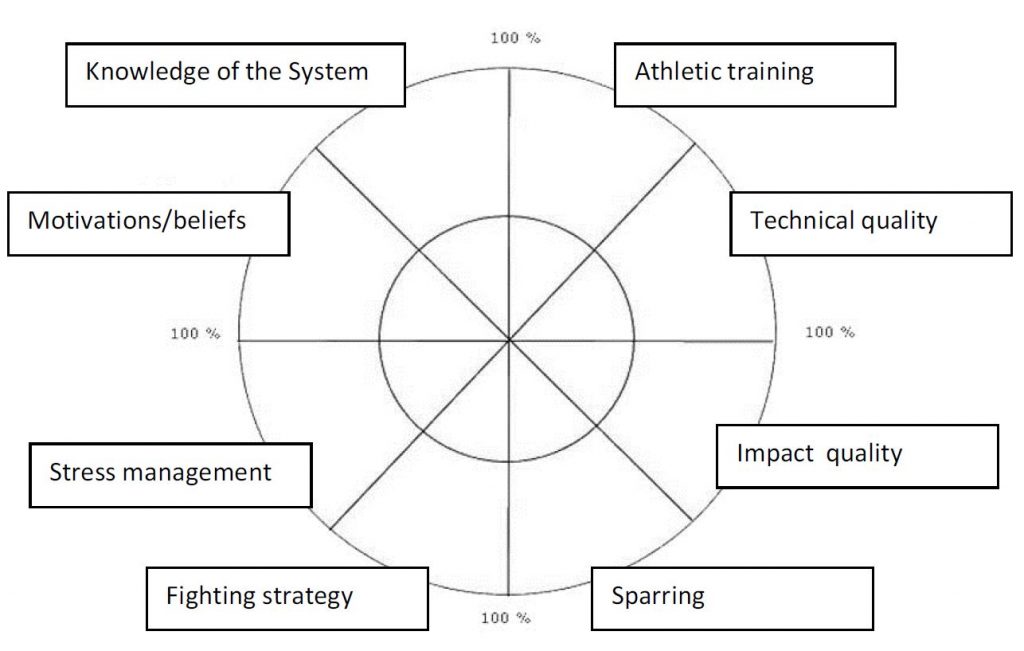
The tool that we use for the assessment of  is the wheel into wedges.


wheel_into_wedges


A small description of the various segments:
1) athletic training: coordination, flexibility, balance, strength, speed, power, endurance…;
2) Technical Quality: As the name says, the quality of technical movements,  from the single technique, to the drill , to the more complex sequence;
3) impact Quality: The level  of conditioning of arms and legs from  by the Iron palm training, and  the ability to impact with power and precision on various pads/bags;
4) Sparring: The ability to apply drills in a non cooperative context.;
5) Combat Strategy: The ability to change fighting strategy to adapt it to the kind  of opponent and kind of fighting;
6) Stress Management: The ability to remain focused under pressure;
7) Motivations / beliefs: The reasons that led you to practice Wing Chun and beliefs on Wing Chun and about yourself;
8) System Knowledge: Knowledge of the principles and strategies of Wing Chun.
Now, for the analysis, just give a score from 1 to 100 for each sector and the paint   the corresponding wheel sector according to  this value. If in an area you feel perfectly satisfied, give 100 and paint the entire sector . Analyze the next sector and so on  until the entire wheel is covered.
When you finish, look at the entire wheel..
Example:
A Wing Chun practitioner has an excellent technical quality, he is good in drills in an uncooperative environment, he has an excellent knowledge of the system, it is motivated and with a great confidence in himself.
A great practitioner, right?
Still, let’s assume that he is not able to fight well and he begins  to think Wing Chun doesn’t work. Where the problem may lie?
If we analyze all sectors, we may see that he lacks  in athletic training (he’s not able to hit with power), he  lacks of  impact quality (his hands and shins are not conditioned), when he  is under pressure he panics and fails in applying techniques and his  strategy, even if is good , is not  good enough to adapt him to the opponent or to the kind of fight.

So, with a better analysis, we find that what we considered a good practitioner, is not so good, and we have found where he lacks and what he as to train more.

We also prove him that it is his fault and not Wing Chun fault.
The model we are examining is called the wheel because it should be able to roll. The first analysis to do so is the entire model.
Always ask yourself If this were a real wheel, would you  put it to on your car?

When everything is good, this is what you should have: A harmonic wheel.

CrossFit

What is Crossfit?

CrossFit is a regime of fitness developed by Greg Glassman over several decades. Glassman, founder and CEO of CrossFit, was the first person in history to redefine fitness, in a measured and sensible manner with the increase in performance through vast beaches of work varied and timed. He then created a program specifically designed to improve fitness and health.

CrossFit is a variety of exercises carried out at relatively high intensity. All CrossFit workouts are based on functional movements, and these movements reflect the best aspects of gymnastics, weightlifting, running, rowing, and others.

These are the basic movements of everyday life. The crossfitters can move heavy loads over long distances, this are so movements perfect for maximizing the amount of work performed within a time course.

The intensity is essential for results that are then measured and divided by time or power.

More working time courses, greater will be the output power and more intense effort.

It is using an approach constantly varied exercises, functional movements and intensity you will get spectacular gains on your fitness.

That sense of community that develops spontaneously when people do the workouts together is a key component of the effectiveness of CrossFit. This community to gave birth today to a global network of over 11,000 affiliates.

Cultivate the natural camaraderie, the spirit of competition and the pleasure of sport gives an intensity that cannot be matched otherwise.

The CrossFit program is driven by statistics.

The use of whiteboards as dashboards, recording the results and records, the creation of specific issues, the timing of each activity, and then redefining clarifies rules and performance goals. It does not motivate only for the following results but also for the objective and analysis on statistics for each workout.

Overall, the CrossFit to designed a general fitness, supported by measurable, observable and reproducible results.

The program prepares students for any eventuality, not only physical, for the unknown, but for the unpredictable also.

Crossfit and Wing Chun: “by Carlos Sousa – CRCA-PORTO (Portugal) an active member”

I practice Crossfit for over 4 years now and in my case, it helped me a lot to improve my Wing Chun. The idea of Wing Chun is to pull, push, hit, run away from the opponent, to the opponent, be fast in our movements such as blocking and attacks and maintain its balance at any moment.

Control of the body is not only possible through the formation of Wing Chun, but for this it is necessary to improve our control to apply it against an opponent.

Wing Chun demonstrates how to use the strength of the opponent and hit back through his power. But do you think that all these concepts can be improved with training of power, cardiovascular, body control, etc…?

Over the years, I do a search on the street fights and competitions and I realized that in 90% of defeats combatants who lose, are out of breath and start to be very tired just before losing the fight. It is therefore of great importance for us (amateur martial arts) try to stay fresh as long as possible during a fight.

It is very difficult to plan an offensive tactic or to block the attack of an opponent if we are very tired or short of breath, this is why that I integrated into my training exercises to stay sharp as long as possible.

The type of training that I am stirring Crossfit and Wing Chun is based on these keys I’m talking about above. Here is an example of training to simplify your understanding:

To begin with, I am doing a normal warmup as everyone knows to do. Rotations of the arms, legs and the rest of the body with light stretching copying the movements of the body that I’ll use later under stress and effort, and then I do 1 km run or 5 minutes of jump rope.

Once the warm-up finished, I chained the following sequences to fatigue me: (based on the Crossfit program)

AMRAP 20′ (AMRAP means “as many series as possible in 20 minutes)

5 pull-ups

10 push ups

15 squats

Always try to give the best of yourself and always follow your results; in this case, your serial numbers. This way you can see your performance to improve day by day.

In the end, without rest, with a partner, I perform a blocking Tan Sau, and with another I give 5 demonstrations blocking Tan Sau against a Jab. Two blows, kicks, as in an attack then the ground fighting. I try to do this very quickly to try to end up tired and out of breath.

If I’m alone, I write on paper exercises, this has the same effect as creating a tactic when you are fatigued.

When I finished situations I choose a fresh partner and made 2 sets of 3 minutes of training of shots using only Wing Chun techniques.

On the first series I leave the opponent hit me punching or kicking in a free way using only complex attacks and attacks.

For the second series I freely use all the techniques of Wing Chun.

If I don’t have a partner, I use the Dummy, punch bag and double PEAR attached representing the opponent.

Remember the example here we give to aims to show how I associate the Crossfit and Wing Chun.

In the future, I will only give advice to the CrossFit workouts.

Assume you all know how Wing Chun works and how you can associate it with the CrossFit (if you have more questions about Wing Chun you can always contact Sifu Mario Lopez.)

ACRONYMS / abbreviations which will be needed.

AMRAP – as many rounds as possible

BP – benchpress

BS – back squat

BW – bodyweight

C & J – clean and jerk

DL – deadlift

DB – dumbells

FS – front squat

HPC – hng clean power

HS – handstand

HSPU – handstand push ups

KB – kettlebell

K2E – Knees to elbows

MU – muscle up

OH – overhead

OHS – overhead squat

PC – power clean

PJ – push jerk

PP – push press

PU – pull up

REPS – rehearsals

RM – repetition maximum

SDHP – sumo deadlift high pull

SJ – split jerk

TABATA – 8 round of 20 second workout and 10 seconds rest

T2B – toes to bar

WOD – workout of the day

For future workouts if you see a few abbreviations that you don’t know, go back to this list.